the Face Jesus in Art a 2001 Documentary Series

The depiction of Jesus in pictorial class dates back to early Christian fine art and architecture, equally aniconism in Christianity was rejected within the ante-Nicene period.[1] [2] [3] [4] It took several centuries to reach a conventional standardized class for his physical advent, which has subsequently remained largely stable since that time. Almost images of Jesus accept in common a number of traits which are now almost universally associated with Jesus, although variants are seen.
The conventional paradigm of a fully bearded Jesus with long hair emerged around Advertizement 300, but did non go established until the sixth century in Eastern Christianity, and much afterwards in the West.[ commendation needed ] It has ever had the advantage of being easily recognizable, and distinguishing Jesus from other figures shown around him, which the use of a cruciform halo also achieves. Earlier images were much more varied.
Images of Jesus tend to show indigenous characteristics like to those of the culture in which the prototype has been created. Beliefs that certain images are historically authentic, or have acquired an authoritative status from Church tradition, remain powerful among some of the faithful, in Eastern Orthodoxy, Anglicanism, and Roman Catholicism. The Shroud of Turin is now the best-known example, though the Image of Edessa and the Veil of Veronica were better known in medieval times.[ non verified in body ]
In that location is only 1 description of the concrete advent of Jesus given in the New Attestation, which is in the Book of Revelation 1:12-16.
Early Christianity [edit]
Before Constantine [edit]

Except for Jesus wearing tzitzit—the tassels on a tallit—in Matthew 14:36[5] and Luke eight:43–44,[6] in that location is no physical description of Jesus independent in any of the canonical Gospels. In the Acts of the Apostles, Jesus is said to have manifested as a "low-cal from heaven" that temporarily blinded the Apostle Paul, but no specific class is given. In the Book of Revelation in that location is a vision the author had of "someone like a Son of Human" in spirit course: "dressed in a robe reaching down to his anxiety and with a golden sash effectually his breast. The hair on his head were white similar wool, and his eyes were like blazing burn down. His feet were like burnt bronze glowing in a furnace (...) His face was like the dominicus shining in all its brilliance" (Revelation 1:12–16, NIV). Use in art of the Revelation description of Jesus has more often than not been restricted to illustrations of the volume itself, and cypher in the scripture confirms the spiritual form's resemblance to the physical course Jesus took in his life on World.

Exodus xx:4–6 "Thou shalt not make unto thee any graven epitome" is one of the Ten Commandments and fabricated Jewish depictions of first-century individuals a scarcity. Merely attitudes towards the interpretation of this Commandment changed through the centuries, in that while showtime-century rabbis in Judea objected violently to the depiction of human figures and placement of statues in Temples, tertiary-century Babylonian Jews had different views; and while no figural art from first-century Roman Judea exists, the fine art on the Dura synagogue walls developed with no objection from the Rabbis early on in the tertiary century.[vii]
During the persecution of Christians under the Roman Empire, Christian art was necessarily furtive and ambiguous, and in that location was hostility to idols in a grouping still with a large component of members with Jewish origins, surrounded by, and polemicising against, sophisticated pagan images of gods. Irenaeus (d. c. 202), Clement of Alexandria (d. 215), Lactantius (c. 240–c. 320) and Eusebius of Caesarea (d. c. 339) disapproved of portrayals in images of Jesus.[ citation needed ] The 36th canon of the non-ecumenical Synod of Elvira in 306 Advertisement reads, "Information technology has been decreed that no pictures be had in the churches, and that which is worshipped or adored be not painted on the walls",[8] which has been interpreted by John Calvin and other Protestants every bit an interdiction of the making of images of Christ.[9] The result remained the subject area of controversy until the end of the 4th century.[x]
The earliest surviving Christian art comes from the late 2nd to early on quaternary centuries on the walls of tombs belonging, most probable, to wealthy[11] Christians in the catacombs of Rome, although from literary testify in that location may well have been panel icons which, like almost all classical painting, accept disappeared.

The Healing of the Paralytic – one of the oldest possible depictions of Jesus,[12] from the Syrian city of Dura Europos, dating from nearly 235
Initially Jesus was represented indirectly by pictogram symbols such as the ichthys (fish), the peacock, or an anchor (the Labarum or Chi-Rho was a later development). The staurogram seems to take been a very early representation of the crucified Jesus within the sacred texts. Later personified symbols were used, including Jonah, whose three days in the belly of the whale pre-figured the interval between Christ's death and resurrection; Daniel in the lion's den; or Orpheus mannerly the animals.[13] The prototype of "The Proficient Shepherd", a beardless youth in pastoral scenes collecting sheep, was the near common of these images, and was probably not understood as a portrait of the historical Jesus at this menstruum.[fourteen] Information technology continues the classical Kriophoros ("ram-bearer" effigy), and in some cases may also represent the Shepherd of Hermas, a popular Christian literary piece of work of the 2nd century.[15]
Among the earliest depictions clearly intended to directly represent Jesus himself are many showing him as a baby, usually held past his female parent, especially in the Admiration of the Magi, seen as the first theophany, or display of the incarnate Christ to the world at large.[sixteen] The oldest known portrait of Jesus, constitute in Syrian arab republic and dated to about 235, shows him as a beardless young man of authoritative and dignified bearing. He is depicted dressed in the style of a young philosopher, with close-cropped hair and wearing a tunic and pallium—signs of good convenance in Greco-Roman society. From this, it is evident that some early on Christians paid no heed to the historical context of Jesus beingness a Jew and visualised him solely in terms of their own social context, as a quasi-heroic figure, without supernatural attributes such every bit a halo.[17]
The advent of Jesus had some theological implications. While some Christians thought Jesus should accept the beautiful appearance of a young classical hero,[18] and the Gnostics tended to retrieve he could change his appearance at will, for which they cited the Coming together at Emmaus as testify,[19] others including the Church Fathers Justin (d. 165) and Tertullian (d. 220) believed, post-obit Isaiah:53:2, that Christ'due south appearance was unremarkable:[20] "he had no form nor comeliness, that we should wait upon him, nor beauty that we should delight in him." But when the infidel Celsus ridiculed the Christian religion for having an ugly God in about 180, Origen (d. 248) cited Psalm 45:3: "Gird thy sword upon thy thigh, mighty one, with thy beauty and fairness"[21] Later the emphasis of leading Christian thinkers changed; Jerome (d. 420) and Augustine of Hippo (d. 430) argued that Jesus must have been ideally beautiful in face and torso. For Augustine he was "beautiful every bit a child, beautiful on earth, beautiful in sky."

From the 3rd century onwards, the first narrative scenes from the Life of Christ to be clearly seen are the Baptism of Christ, painted in a catacomb in about 200,[23] and the miracle of the Raising of Lazarus,[24] both of which can be clearly identified past the inclusion of the dove of the Holy Spirit in Baptisms, and the vertical, shroud-wrapped trunk of Lazarus. Other scenes remain ambiguous—an agape feast may exist intended as a Concluding Supper, simply before the development of a recognised concrete appearance for Christ, and attributes such as the halo, it is impossible to tell, as tituli or captions are rarely used. There are some surviving scenes from Christ's Works of almost 235 from the Dura Europos church building on the Persian frontier of the Empire. During the quaternary century a much greater number of scenes came to be depicted,[25] usually showing Christ as youthful, beardless and with curt hair that does not reach his shoulders, although in that location is considerable variation.[26]
Jesus is sometimes shown performing miracles by ways of a wand,[27] as on the doors of Santa Sabina in Rome (430–32). He uses the wand to change h2o to vino, multiply the breadstuff and fishes, and raise Lazarus.[28] When pictured healing, he only lays on hands. The wand is thought to be a symbol of power. The bare-faced youth with the wand may bespeak that Jesus was idea of as a user of magic or wonder worker by some of the early Christians.[29] [30] No fine art has been establish picturing Jesus with a wand earlier the 2nd century. Some scholars propose that the Gospel of Mark, the Secret Gospel of Mark and the Gospel of John (the and so-chosen Signs Gospel), portray such a wonder worker, user of magic, a magician or a Divine man.[31] Only the Apostle Peter is besides depicted in ancient art with a wand.[30]
Another depiction, seen from the belatedly third century or early 4th century onwards, showed Jesus with a bristles, and within a few decades can be very close to the conventional type that after emerged.[32] This depiction has been said to draw variously on Imperial imagery, the blazon of the classical philosopher,[33] and that of Zeus, leader of the Greek gods, or Jupiter, his Roman equivalent,[34] and the protector of Rome. According to art historian Paul Zanker, the disguised type has long hair from the start, and a relatively long beard (contrasting with the short "classical" beard and hair e'er given to St Peter, and about other apostles);[35] this delineation is specifically associated with "Charismatic" philosophers like Euphrates the Stoic, Dio of Prusa and Apollonius of Tyana, some of whom were claimed to perform miracles.[36]
Later the very primeval examples of c. 300, this delineation is generally used for hieratic images of Jesus, and scenes from his life are more than probable to use a beardless, youthful blazon.[37] The trend of older scholars such as Talbot Rice to see the beardless Jesus as associated with a "classical" artistic manner and the disguised 1 as representing an "Eastern" one drawing from ancient Syrian arab republic, Mesopotamia and Persia seems impossible to sustain, and does not feature in more recent analyses. Equally attempts to chronicle on a consistent ground the explanation for the type called in a detail work to the differing theological views of the fourth dimension have been unsuccessful.[38] From the 3rd century on, some Christian leaders, such as Clement of Alexandria had recommended the wearing of beards by Christian men.[39] The centre parting was also seen from early on on, and was besides associated with long-haired philosophers.
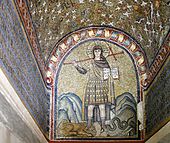
Christ as Emperor, wearing military dress, and crushing the serpent representing Satan. "I am the way and the truth and the life" (John 14:six) reads the inscription. Ravenna, afterward 500
After Constantine [edit]
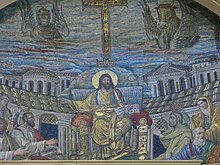
From the center of the quaternary century, after Christianity was legalized by the Edict of Milan in 313, and gained Royal favour, there was a new range of images of Christ the King,[40] using either of the two physical types described in a higher place, but adopting the costume and oftentimes the poses of Majestic iconography. These developed into the diverse forms of Christ in Majesty. Some scholars reject the connectedness between the political events and developments in iconography, seeing the change as a purely theological one, resulting from the shift of the concept and championship of Pantocrator ("Ruler of all") from God the Father (nonetheless not portrayed in fine art) to Christ, which was a evolution of the same menses, perhaps led by Athanasius of Alexandria (d. 373).[41]
Another depiction drew from classical images of philosophers, often shown as a youthful "intellectual wunderkind" in Roman sarcophagii; the Traditio Legis image initially uses this type.[42] Gradually Jesus became shown as older, and during the fifth century the image with a beard and long hair, now with a cruciform halo, came to dominate, peculiarly in the Eastern Empire. In the earliest large New Testament mosaic cycle, in Sant'Apollinare Nuovo, Ravenna (c. 520), Jesus is beardless though the period of his ministry building until the scenes of the Passion, after which he is shown with a beard.[43]
The Good Shepherd, now clearly identified as Christ, with halo and often rich robes, is nonetheless depicted, equally on the apse mosaic in the church building of Santi Cosma e Damiano in Rome, where the twelve apostles are depicted as twelve sheep below the majestic Jesus, or in the Mausoleum of Galla Placidia at Ravenna.
Once the bearded, long-haired Jesus became the conventional representation of Jesus, his facial features slowly began to be standardised, although this procedure took until at least the 6th century in the Eastern Church, and much longer in the West, where clean-shaven Jesuses are common until the twelfth century, despite the influence of Byzantine art. But by the late Middle Ages the bristles became almost universal and when Michelangelo showed a make clean-shaven Apollo-like Christ in his Last Judgment fresco in the Sistine Chapel (1534–41) he came nether persistent attack in the Counter-Reformation climate of Rome for this, too equally other things.[44]
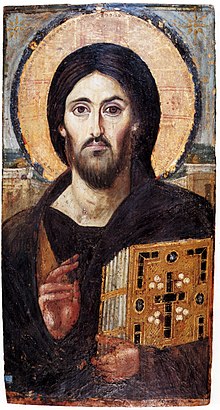
French scholar Paul Vignon has listed 15 similarities ("marks", similar tilaka)[45] betwixt most of the icons of Jesus after this point, particularly in the icons of "Christ Pantocrator" ("The anointed Messiah"). He claims that these are due to the availability of the Image of Edessa (which he claims to be identical to the Shroud of Turin, via Constantinople)[46] to the artists. Certainly images believed to have miraculous origins, or the Hodegetria, believed to be a portrait of Mary from the life by Saint Luke, were widely regarded as administrative by the Early Medieval period and greatly influenced depictions. In Eastern Orthodoxy the form of images was, and largely is, regarded as revealed truth, with a condition most equal to scripture, and the aim of artists is to copy earlier images without originality, although the style and content of images does in fact change slightly over time.[47]
Equally to the historical appearance of Jesus, in 1 possible translation of the apostle Paul's First Epistle to the Corinthians, Paul urges Christian men of kickoff-century Corinth not to have long pilus.[48] An early on commentary by Pelagius (c. AD 354 – c. Ad 420/440) says, "Paul was complaining because men were fussing near their hair and women were flaunting their locks in church. Not only was this dishonoring to them, only it was also an incitement to fornication."[49] Some[ who? ] have speculated that Paul was a Nazirite who kept his pilus long[ citation needed ] fifty-fifty though such speculation is at odds with Paul's statement in I Corinthians xi:14 that long hair for men was shameful at the time. Jesus was a practicing Jew then presumably had a beard.[ citation needed ]
Later periods [edit]
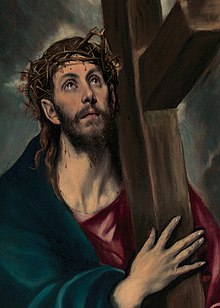
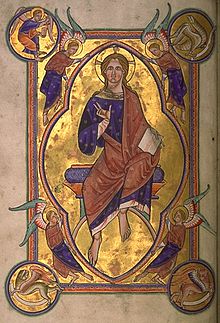
Past the 5th century depictions of the Passion began to announced, perhaps reflecting a change in the theological focus of the early Church.[50] The 6th-century Rabbula Gospels includes some of the earliest surviving images of the crucifixion and resurrection.[l] By the 6th century the bearded depiction of Jesus had get standard in the East, though the West, specially in northern Europe, connected to mix bearded and unbearded depictions for several centuries. The depiction with a longish face, long straight brown hair parted in the centre, and almond shaped optics shows consistency from the 6th century to the present. Various legends developed which were believed to authenticate the historical accurateness of the standard depiction, such as the image of Edessa and later the Veil of Veronica.[51]
Partly to aid recognition of the scenes, narrative depictions of the Life of Christ focused increasingly on the events celebrated in the major feasts of the church agenda, and the events of the Passion, neglecting the miracles and other events of Jesus' public ministry, except for the raising of Lazarus, where the mummy-like wrapped torso was shown standing upright, giving an unmistakable visual signature.[52] A cruciform halo was worn just by Jesus (and the other persons of the Trinity), while plain halos distinguished Mary, the Apostles and other saints, helping the viewer to read increasingly populated scenes.[52]
The period of Byzantine Iconoclasm acted as a bulwark to developments in the East, only by the 9th century art was permitted over again. The Transfiguration of Jesus was a major theme in the East and every Eastern Orthodox monk who had trained in icon painting had to prove his craft by painting an icon of the Transfiguration.[53] However, while Western depictions increasingly aimed at realism, in Eastern icons a low regard for perspective and alterations in the size and proportion of an image aim to reach beyond earthly reality to a spiritual meaning.[54]
The 13th century witnessed a turning point in the portrayal of the powerful Kyrios image of Jesus as a wonder worker in the West, as the Franciscans began to emphasize the humility of Jesus both at his birth and his death via the nativity scene as well equally the crucifixion.[55] [56] [57] The Franciscans approached both ends of this spectrum of emotions and as the joys of the Nativity of were added to the desperation of crucifixion a whole new range of emotions were ushered in, with wide-ranging cultural bear on on the image of Jesus for centuries thereafter.[55] [57] [58] [59]
Afterward Giotto, Fra Angelico and others systematically developed uncluttered images that focused on the depiction of Jesus with an ideal human dazzler, in works like Leonardo da Vinci's Concluding Supper, arguably the first High Renaissance painting.[threescore] [61] Images of Jesus now drew on classical sculpture, at least in some of their poses. All the same Michelangelo was considered to have gone much too far in his beardless Christ in his The Terminal Judgment fresco in the Sistine Chapel, which very clearly adjusted classical sculptures of Apollo, and this path was rarely followed past other artists.
The High Renaissance was contemporary with the offset of the Protestant Reformation which, especially in its first decades, violently objected to almost all public religious images as idolatrous, and vast numbers were destroyed. Gradually images of Jesus became acceptable to most Protestants in various contexts, especially in narrative contexts, as book illustrations and prints, and later in larger paintings. Protestant art continued the now-standard delineation of the physical appearance of Jesus. Meanwhile, the Catholic Counter-Reformation re-affirmed the importance of art in assisting the devotions of the faithful, and encouraged the production of new images of or including Jesus in enormous numbers, also continuing to use the standard depiction.
During the 17th century, some writers, such every bit Thomas Browne in his Pseudodoxia Epidemica criticized depictions of Jesus with long hair. Although some scholars believed that Jesus wore long pilus considering he was a Nazarite and therefore could not cutting his hair, Browne argues "that our Saviour was a Nazarite after this kind, we accept no reason to determine; for he drank Wine, and was therefore called past the Pharisees, a Wine-bibber; he approached also the dead, equally when he raised from death Lazarus, and the daughter of Jairus."[62]
Past the end of the 19th century, new reports of miraculous images of Jesus had appeared and continue to receive significant attention, e.g. Secondo Pia's 1898 photograph of the Shroud of Turin, one of the nearly controversial artifacts in history, which during its May 2010 exposition it was visited by over ii million people.[63] [64] [65] Another 20th-century depiction of Jesus, namely the Divine Mercy image based on Faustina Kowalska's reported vision has over 100 meg followers.[66] [67] The first cinematic portrayal of Jesus was in the 1897 picture show La Passion du Christ produced in Paris, which lasted v minutes.[68] [69] Thereafter cinematic portrayals take connected to evidence Jesus with a beard in the standard western delineation that resembles traditional images.[70]
A scene from the documentary moving picture Super Size Me showed American children existence unable to identify a common depiction of Jesus, despite recognizing other figures like George Washington and Ronald McDonald.[71]
Conventional depictions [edit]
Conventional depictions of Christ adult in medieval art include the narrative scenes of the Life of Christ, and many other conventional depictions:
Common narrative scenes from the Life of Christ in art include:
- Nativity of Jesus in art
- Adoration of the Shepherds
- Adoration of the Magi
- Finding in the Temple
- Baptism of Jesus
- Crucifixion of Jesus
- Descent from the Cantankerous
- Last Sentence
Devotional images include:
- Madonna and child
- Christ in Majesty
- Christ Pantokrator
- Sacred Center
- Pietà (mother and dead son)
- Lamb of God
- Man of sorrows
- Pensive Christ
Range of depictions [edit]
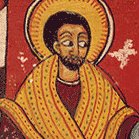
Certain local traditions have maintained different depictions, sometimes reflecting local racial characteristics, as practice the Catholic and Orthodox depictions. The Coptic Church of Egypt separated in the 5th century, and has a distinctive depiction of Jesus, consequent with Coptic fine art. The Ethiopian Church building, also Coptic, adult on Coptic traditions, only shows Jesus and all Biblical figures with the Ethiopian advent of its members.[ citation needed ] Other traditions in Asia and elsewhere as well testify the race of Jesus as that of the local population (come across Chinese picture in the gallery beneath). In modernistic times such variation has become more common, only images following the traditional depiction in both concrete appearance and clothing are still dominant, peradventure surprisingly so. In Europe, local indigenous tendencies in depictions of Jesus can be seen, for instance in Spanish, High german, or Early on Netherlandish painting, merely almost ever surrounding figures are notwithstanding more strongly characterised. For example, the Virgin Mary, after the vision reported by Bridget of Sweden, was often shown with blonde hair, merely Christ'south is very rarely paler than a lite brown.
Some medieval Western depictions, usually of the Meeting at Emmaus, where his disciples exercise not recognise him at get-go (Luke.24.xiii–32), showed Jesus wearing a Jewish hat.[72]
The CGI model created in 2001 depicted Jesus' peel color every bit existence darker and more than olive-colored than his traditional depictions in Western art.
In 2001, the television series Son of God used ane of three kickoff-century Jewish skulls from a leading department of forensic scientific discipline in Israel to describe Jesus in a new way.[73] A face was synthetic using forensic anthropology by Richard Neave, a retired medical artist from the Unit of Art in Medicine at the University of Manchester.[74] The face that Neave synthetic suggested that Jesus would have had a broad face and large nose, and differed significantly from the traditional depictions of Jesus in renaissance art.[75] Additional data about Jesus' peel colour and hair was provided by Mark Goodacre, a New Testament scholar and professor at Duke University.[75]
Using 3rd-century images from a synagogue—the earliest pictures of Jewish people[76]—Goodacre proposed that Jesus' skin color would accept been darker and swarthier than his traditional Western image. He likewise suggested that he would have had brusk, curly pilus and a short cropped beard.[77] Although entirely speculative as the face of Jesus,[74] the consequence of the study adamant that Jesus' skin would have been more olive-colored than white or black,[75] and that he would take looked like a typical Galilean Semite. Among the points made was that the Bible records that Jesus'due south disciple Judas had to point him out to those arresting him in Gethsemane. The unsaid argument is that if Jesus's concrete appearance had differed markedly from his disciples, then he would have been relatively easy to identify.[77]
Miraculous images of Jesus [edit]
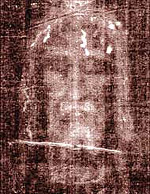
At that place are, withal, some images which have been claimed to realistically show how Jesus looked. One early tradition, recorded by Eusebius of Caesarea, says that Jesus one time done his face with h2o and so dried information technology with a fabric, leaving an prototype of his face imprinted on the textile. This was sent by him to King Abgarus of Edessa, who had sent a messenger request Jesus to come and heal him of his illness. This image, called the Mandylion or Epitome of Edessa, appears in history in around 525. Numerous replicas of this "prototype not fabricated by homo hands" remain in apportionment. There are also icon compositions of Jesus and Mary that are traditionally believed by many Orthodox to have originated in paintings past Luke the Evangelist.
A currently familiar depiction is that on the Shroud of Turin, whose records go back to 1353. Controversy surrounds the shroud and its exact origin remains subject to debate.[78] The Shroud of Turin is respected by Christians of several traditions, including Baptists, Catholics, Lutherans, Methodists, Orthodox, Pentecostals, and Presbyterians.[79] Information technology is 1 of the Cosmic devotions approved by the Holy See, that to the Holy Face of Jesus, now uses the prototype of the confront on the shroud as it appeared in the negative of the photograph taken by apprentice photographer Secondo Pia in 1898.[80] [81] The image cannot be conspicuously seen on the shroud itself with the naked centre, and it surprised Pia to the extent that he said he almost dropped and broke the photographic plate when he first saw the developed negative image on it in the evening of 28 May 1898.[81]
Earlier 1898, devotion to the Holy Face of Jesus used an prototype based on the Veil of Veronica, where fable recounts that Veronica from Jerusalem encountered Jesus forth the Via Dolorosa on the mode to Calvary. When she paused to wipe the sweat from Jesus'south face with her veil, the epitome was imprinted on the cloth. The establishment of these images as Catholic devotions traces back to Sister Marie of St Peter and the Venerable Leo Dupont who started and promoted them from 1844 to 1874 in Tours France, and Sister Maria Pierina De Micheli who associated the prototype from the Shroud of Turin with the devotion in 1936 in Milan Italy.
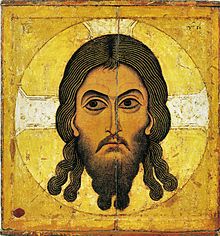
"The Saviour Not Made by Hands", a Novgorodian icon from c. 1100 based on a Byzantine model
A very popular 20th-century depiction among Roman Catholics and Anglicans is the Divine Mercy image,[82] which was approved by Pope John Paul II in April 2000.[83] The Divine Mercy delineation is formally used in celebrations of Divine Mercy Sunday and is venerated by over 100 one thousand thousand Catholics who follow the devotion.[67] The image is not part of Acheiropoieta in that it has been depicted past modernistic artists, but the pattern of the image is said to have been miraculously shown to Saint Faustina Kowalska in a vision of Jesus in 1931 in Płock, Poland.[83] Faustina wrote in her diary that Jesus appeared to her and asked her to "Pigment an epitome co-ordinate to the pattern you meet".[83] [84] Faustina somewhen found an artist (Eugene Kazimierowski) to depict the Divine Mercy image of Jesus with his correct paw raised in a sign of blessing and the left hand touching the garment near his breast, with ii large rays, one red, the other white emanating from almost his center.[84] [85] Subsequently Faustina's decease, a number of other artists painted the epitome, with the delineation by Adolf Hyla existence amongst the almost reproduced.[86]
Warner Sallman stated that The Head of Christ was the result of a "miraculous vision that he received tardily one night", proclaiming that "the answer came at 2 A.M., Jan 1924" as "a vision in response to my prayer to God in a despairing situation."[87] The Head of Christ is venerated in the Coptic Orthodox Church,[88] after twelve-twelvemonth-sometime Isaac Ayoub, who diagnosed with cancer, saw the eyes of Jesus in the painting shedding tears; Fr. Ishaq Soliman of St. Marker'south Coptic Church in Houston, on the same day, "testified to the miracles" and on the next 24-hour interval, "Dr. Atef Rizkalla, the family dr., examined the youth and certified that there were no traces of leukemia".[89] With episcopal approval from Bishop Tadros of Port Said and Bishop Yuhanna of Cairo, "Sallman's Caput of Christ was exhibited in the Coptic Church", with "more than fifty thousand people" visiting the church to come across it.[89] In addition, several religious magazines accept explained the "power of Sallman'south flick" by documenting occurrences such as headhunters letting go of a businessman and fleeing after seeing the paradigm, a "thief who aborted his misdeed when he saw the Caput of Christ on a living room wall", and deathbed conversions of non-believers to Christianity.[90] As an extraordinarily successful work of Christian popular devotional art,[91] it had been reproduced over half a billion times worldwide by the end of the 20th century.[92]
Controversies [edit]
The representation of Jesus has been controversial since the Synod of Elvira in 306 which states in the 36th canon that no worship epitome should be found in a church building. [93]
In the 16th century, John Calvin and other Protestant reformers denounced the idolatry of images of Christ and called for their removal.[94] Due to their agreement of the 2nd of the Ten Commandments, almost Evangelicals do not have a representation of Jesus in their places of worship.[95] [96]
Examples [edit]
-
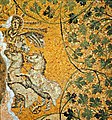
A representation of Jesus riding in his chariot. Mosaic of the third century on the Vatican grottoes under St. Peter's Basilica.
-

Jesus depicted on an early on 8th-century Byzantine coin. After the Byzantine iconoclasm all coins had Christ on them.
-

-

Reconstruction of the enthroned Jesus ( Yišō ) image on a Manichaean temple banner from c. 10th-century Qocho (East Fundamental Asia).
-
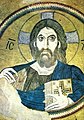
11th-century Christ Pantocrator with the halo in a cross form, used throughout the Middle Ages. Characteristically, he is portrayed equally like in features and peel tone to the culture of the creative person.
-
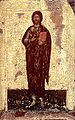
"Christ All Mercy" Eastern Orthodox icon.
-

-

-

-
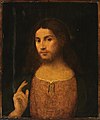
Palma il Vecchio, Head of Christ, 16th century, Italy
-
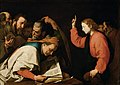
Jesus, aged 12, Jesus among the Doctors (as a child debating in the temple), 1630 by Jusepe de Ribera.
-
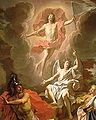
-

Trevisani's delineation of the typical baptismal scene with the sky opening and the Holy Spirit descending every bit a dove, 1723.
-
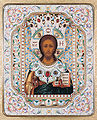
19th-century Russian icon of Christ Pantocrator.
-

A nineteenth-century Chinese depiction of Jesus and the rich man, from Marker affiliate ten.
-

A traditional Ethiopian depiction of Jesus and Mary with distinctively Ethiopian features.
-

-
-

Man dressed in Jesus costume.
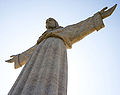
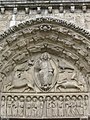
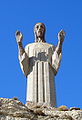
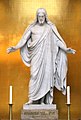
Sculpture [edit]
-
-

-
-
-
-

Baby Jesus of Prague, one of several miniature statues of an infant Christ that are much venerated by the faithful
-

Come across also [edit]
- Category:Cultural depictions of Jesus
- Crucifixion
- God the Father in Western art
- Holy bill of fare
- Ichthys
- Perceptions of religious imagery in natural phenomena
- Race of Jesus
- Resurrection of Jesus in Christian art
- Salvator Mundi
- Veil of Veronica
- Passion Play
- Christ figure
Notes [edit]
- ^ Philip Schaff commenting on Irenaeus, wrote, 'This censure of images equally a Gnostic peculiarity, and as a heathenish abuse, should be noted'. Footnote 300 on Contr. Her. .I.XXV.6. ANF
- ^ Synod of Elvira, 'Pictures are not to be placed in churches, then that they exercise not become objects of worship and admiration', Ad 306, Canon 36
- ^ Kitzinger, Ernst, "The Cult of Images in the Age before Iconoclasm", Dumbarton Oaks Papers, Vol. eight, (1954), pp. 83–150, Dumbarton Oaks, Trustees for Harvard University, JSTOR
- ^ "The Early on Church on the Aniconic Spectrum". The Westminster Theological Journal. 83 (ane): 35–47. ISSN 0043-4388. Retrieved 2 March 2022.
- ^ Matthew 14:46
- ^ Luke 8:43–44
- ^ Harold W. Attridge, Gohei Hata, et al. Eusebius, Christianity, and Judaism. Wayne, MI: Wayne Land University Press, 1992. pp. 283–284.
- ^ English translation found at Cosmic University of America, accessed 5 September 2012 [1]
- ^ John Calvin Institutes of the Christian Religion Book 1, Affiliate V. Section six.
- ^ Hellemo, pp. 3–6, and Cartlidge and Elliott, 61 (Eusebius quotation) and passim. Clement approved the use of symbolic pictograms.
- ^ The Second Church: Popular Christianity A.D. 200–400 past Ramsay MacMullen, The Society of Biblical Literature, 2009
- ^ McKay, John; Loma, Bennett (2011). A History of World Societies, Combined Volume (ix ed.). Usa: Macmillan. p. 166. ISBN978-0-312-66691-0 . Retrieved five August 2013.
- ^ Orpheus every bit a symbol for David was already found in hellenized Jewish art. Hall, 66
- ^ Syndicus, 21–iii
- ^ Cartlidge and Elliott, 53–55. Run into besides The Two Faces of Jesus by Robin 1000. Jensen, Bible Review, 17.viii, October 2002, and Understanding Early Christian Art by Robin M. Jensen, Routledge, 2000
- ^ Hall, 70–71
- ^ Brandon, S.M.F, "Christ in verbal and depicted imagery". Neusner, Jacob (ed.): Christianity, Judaism and other Greco-Roman cults: Studies for Morton Smith at sixty. Part 2: Early Christianity, pp. 166–167. Brill, 1975. ISBN 978-90-04-04215-5
- ^ Zanker, 299
- ^ Every, George; Christian Mythology, p. 65, Hamlyn 1988 (1970 1st edn.) ISBN 0-600-34290-v
- ^ Syndicus, 92
- ^ Cartlidge and Elliott, 53 – this is Psalm 44 in the Latin Vulgate; English language bible translations prefer "celebrity" and "majesty"
- ^ Zanker, 302.
- ^ Schiller, I 132. The epitome comes from the crypt of Lucina in the Catacombs_of_San_Callisto. There are a number of other 3rd-century images.
- ^ Painted over xl times in the catacombs of Rome, from the early 3rd century on, and also on sarcophagii. Every bit with the Baptism, some early on examples are from Gaul. Schiller, I, 181
- ^ Syndicus, 94–95
- ^ Syndicus, 92–93, Crypt images
- ^ "Catholic Encyclopedia: Portraits of the Apostles". Retrieved ten August 2008.
- ^ Cartlidge and Elliott, sixty
- ^ The Two Faces of Jesus past Robin Thou. Jensen, Bible Review, 17.8, Oct 2002
- ^ a b New Catholic Encyclopedia: Portraits of the Apostles
- ^ Jesus, the Wizard by Morton Smith, Harper & Row, 1978
- ^ Zanker, 302
- ^ Zanker, 300–303, who is rather dismissive of other origins for the type
- ^ Syndicus, 93
- ^ Cartlidge and Elliott, 56–57. St Paul ofttimes has a long beard, but short hair, as in the catacomb fresco illustrated. St John the Baptist also oft has long hair and a bristles, and ofttimes retains in later fine art the thick shaggy or wavy long hair seen on some of the earliest depictions of Jesus, and in images of philosophers of the Charismatic type.
- ^ Zanker, 257–266 on the charismatics; 299–306 on the type used for Christ
- ^ Zanker, pp. 299, note 48, and 300. [2]. Meet as well Cartlidge and Elliott, 55–61.
- ^ Grabar, 119
- ^ Zanker, 290
- ^ Syndicus, 92–97, though images of Christ the Male monarch are found in the previous century also – Hellemo, six
- ^ Hellemo, 7–14, citing Thou. Berger in particular.
- ^ Zanker, 299. Zanker has a full business relationship of the development of the image of Christ at pp. 289–307.
- ^ The two parts of the cycle are on reverse walls of the nave; Talbot Rice, 157. Bridgeman Library
- ^ "Last Judgment", Esperanca Camara, Khan Academy; Blunt Anthony, Creative Theory in Italy, 1450–1600, 112–114, 118–119 [1940] (refs to 1985 edn), OUP, ISBN 0198810504
- ^ The Shroud of Christ ("marks") by Paul Vignon, Paul Tice, (2002 – ISBN i-885395-96-5)
- ^ The Shroud of Christ ("Constantinople") past Paul Vignon, Paul Tice, op. cit.
- ^ Grigg, 5–7
- ^ Regarding the alternate NIV translation of i Corinthians xi:7, and in agreement with modern interpretations of the New Testament, Walvoord and Zuck note, "The alternating translation in the NIV margin, which interprets the man's covering as long hair, is largely based on the view that verse 15 equated the roofing with long pilus. Information technology is unlikely, however, that this was the point of verse 4." John F. Walvoord and Roy B. Zuck, eds., The Bible Knowledge Commentary: New Testament, "1 Corinthians xi:4", (Wheaton: Victor Books, 1983)
- ^ Institute for Classical Christian Studies (ICCS) and Thomas Oden, eds., The Aboriginal Christian Commentary Serial, "1 Corinthians 1:4", (Westmont: Inter-Varsity Press, 2005), ISBN 0-8308-2492-viii. Google Books
- ^ a b The New Westminster Dictionary of Church History by Robert Benedetto 2006 ISBN 0-8264-8011-X pp. 51–53
- ^ Jensen, Robin M. (2010). "Jesus in Christian art". In Burkett, Delbert (ed.). The Blackwell Companion to Jesus. John Wiley & Sons. pp. 477–502. ISBN978-1-4443-5175-0.
- ^ a b Iconography of Christian Art, Vol. I by One thousand. Schiller 1971 Lund Humphries, London. figs 150-53, 346-54. ISBN 0-85331-270-2 pp. 181–184
- ^ The epitome of God the Begetter in Orthodox theology and iconography by Steven Bigham 1995 ISBN 1-879038-15-three pp. 226–227
- ^ Archimandrite Vasileios of Stavronikita, "Icons every bit Liturgical Analogies" in Hymn of entry: liturgy and life in the Orthodox church building 1997 ISBN 978-0-88141-026-vi pp. 81–90
- ^ a b The image of St Francis by Rosalind B. Brooke 2006 ISBN 0-521-78291-0 pp. 183–184
- ^ The tradition of Cosmic prayer by Christian Raab, Harry Hagan, St. Meinrad Archabbey 2007 ISBN 0-8146-3184-iii pp. 86–87
- ^ a b The vitality of the Christian tradition by George Finger Thomas 1944 ISBN 0-8369-2378-2 pp. 110–112
- ^ La vida sacra: contemporary Hispanic sacramental theology by James L. Empereur, Eduardo Fernández 2006 ISBN 0-7425-5157-ane pp. 3–5
- ^ Philippines by Lily Rose R. Tope, Detch P. Nonan-Mercado 2005 ISBN 0-7614-1475-4 p. 109
- ^ Experiencing Art Around Us by Thomas Buser 2005 ISBN 978-0-534-64114-6 pp. 382–383
- ^ Leonardo da Vinci, the Terminal Supper: a Cosmic Drama and an Act of Redemption by Michael Ladwein 2006 pp. 27, sixty
- ^ Browne, Thomas. The Works of Thomas Browne Vol. 2. Gutenberg.
- ^ Arthur Barnes, 2003 Holy Shroud of Turin Kessinger Printing ISBN 0-7661-3425-3 pp. 2–9
- ^ William Meacham, The Authentication of the Turin Shroud:An Outcome in Archaeological Epistemology, Electric current Anthropology, Volume 24, No three, June 1983
- ^ "Zenit, May 5, 2010". Zenit.org. 5 May 2010. Archived from the original on 27 September 2012. Retrieved 4 Nov 2011.
- ^ Catherine Chiliad. Odell, 1998, Faustina: Campaigner of Divine Mercy OSV Press ISBN 978-0-87973-923-2 p. 165
- ^ a b Am With Y'all Always by Bridegroom Groeschel 2010 ISBN 978-one-58617-257-2 p. 548
- ^ The Claiming of the Silver Screen (Studies in Organized religion and the Arts) By Freek L. Bakker 2009 ISBN 90-04-16861-3 p. 1
- ^ Encyclopedia of early on cinema by Richard Abe 2005 ISBN 0-415-23440-ix p. 518
- ^ The Blackwell Companion to Jesus edited by Delbert Burkett 2010 ISBN i-4051-9362-10 p. 526
- ^ ""Super Size Me": Recognizing Jesus".
- ^ A 12th-century English example is in the Getty Museum Archived vii June 2010 at the Wayback Machine
- ^ Wells, Matt (27 March 2001). "Is this the real face of Jesus Christ?". The Guardian. London: Guardian. ISSN 0261-3077. OCLC 60623878. Retrieved 12 May 2011.
- ^ a b Legon, Jeordan (25 December 2002). "From scientific discipline and computers, a new face of Jesus". CNN. Retrieved 12 May 2011.
- ^ a b c Wilson, Giles (27 October 2004). "So what color was Jesus?". BBC News. London. Retrieved 12 May 2011.
- ^ "Experts Reconstruct Face Of Jesus". London: CBS. 27 March 2001. Retrieved 12 May 2011.
- ^ a b Fillon, Mike (vii December 2002). "The Real Face Of Jesus". Pop Mechanics. San Francisco: Hearst. ISSN 0032-4558. OCLC 3643271. Retrieved 12 May 2011.
- ^ William Meacham, The Authentication of the Turin Shroud: An Issue in Archaeological Epistemology, Current Anthropology, Book 24, No 3, June 1983
- ^ The Rev. Albert R. Dreisbach (1997). "The Shroud of Turin: Its Ecumenical Implications".
Returning to the ecumenical dimension of this sacred linen, it became very evident to me on the nighttime of Baronial 16, 1983, when local judicatory leaders offered their corporate blessing to the TURIN SHROUD Showroom and participated in the Evening Office of the Holy Shroud. The Greek Archbishop, the Roman Catholic Archbishop, the Episcopal Bishop and the Presiding Bishop of the AME Church gathered earlier the world's first full size, backlit transparency of the Shroud and joined clergy representing the Assemblies of God, Baptists, Lutherans, Methodists and Presbyterians in an amazing witness to ecumenical unity. At the decision of the service, His Grace Bishop John of the Greek Orthodox Diocese of Atlanta, turned to me and said: "Cheers very much for picking our 24-hour interval." I didn't fully understand the significance of his remark until he explained to me that August 16th is the Banquet of the Holy Mandylion commemorating the occasion in 944 A.D. when the Shroud was beginning shown to the public in Byzantium following its arrival the previous day from Edessa in southeastern Turkey.
- ^ Joan Carroll Cruz, 1984, Relics OSV Press ISBN 0-87973-701-8 p. 49
- ^ a b Ann Brawl, 2003 Encyclopedia of Catholic Devotions and Practices ISBN 0-87973-910-X pp. 239, 635
- ^ Brockman, Norbert (2011). Encyclopedia of Sacred Places. ABC-CLIO. p. 140. ISBN978-1-59884-654-6.
- ^ a b c Tim Drake, 2002, Saints of the Jubilee, ISBN 978-ane-4033-1009-5 pp. 85–95
- ^ a b A Divine Mercy Resource by Richard Torretto 2010 ISBN 1-4502-3236-ane "The Image of Divine Mercy" pp. 84–107
- ^ Catherine M. Odell, 1998, Faustina: Campaigner of Divine Mercy OSV Printing ISBN 978-0-87973-923-2 pp. 63–64
- ^ Butler'southward lives of the saints: the tertiary millennium past Paul Burns, Alban Butler 2001 ISBN 978-0-86012-383-5 p. 252
- ^ Morgan, David (1996). Icons of American Protestantism: The Fine art of Warner Sallman. Yale University Press. p. 62. ISBN978-0-300-06342-four.
Sallman e'er insisted that his initial sketch of Jesus was the result of spiritual "picturization," a miraculous vision that he received tardily one dark. "The answer came at 2 A.M., January 1924," he wrote. "It came as a vision in response to my prayer to God in a despairing situation." The situation was a borderline: Sallman had been commissioned to paint the Feb cover for the Covenant Companion, the monthly magazine of the Evangelical Covenant Church building, and he had artist'due south block for weeks. The Feb upshot was focusing on Christian youth, and Sallman's consignment was to provide an inspirational image of Christ that would "challenge our immature people." "I mused over information technology for a long time in prayer and meditation," Sallman recalled, "seeking for something which would catch the eye and convey the message of the Christian gospel on the cover."
- ^ Otto F.A. Meinardus, Ph.D. (Autumn 1997). "Theological Issues of the Coptic Orthodox Inculturation in Western Social club". Coptic Church building Review. eighteen (3). ISSN 0273-3269.
An interesting case of inculturation occurred on Mon, November 11, 1991 when the 12-year-old Isaac Ayoub of Houston, Texas, suffering from leukemia, saw that the eyes of Jesus in the famous Sallman Head of Christ began moving and shedding an oily liquid like tears. On the same day, Fr. Ishaq Soliman, the Coptic priest of St. Mark's Coptic Church in Houston, testified to the miracles. On the following day, Dr. Atef Rizkalla, the family physician, examined the youth and certified that in that location were no traces of leukemia. Sallman's Head of Christ was exhibited in the Coptic Church and more than 50,000 people visited the church. Two Coptic bishops, Anbâ Tadros of Port Said and Anbâ Yuhanna of Cairo verified the story.
- ^ a b Meinardus, Otto F. A. (2006). Christians In Egypt: Orthodox, Cosmic, and Protestant Communities – By and Present. American University in Cairo Press. p. lxx. ISBN978-1-61797-262-1.
An interesting case of inculturation took identify on Mon, November xi, 1991 when the twelve-year-old Isaac Ayoub of Houston, Texas, suffering from leukemia, saw that the eyes of Jesus in the famous Sallman "Head of Christ" began moving and shedding an oily liquid similar tears. On the aforementioned day, Father Ishaq Soliman, the Coptic priest of St. Mark'south Coptic Church building in Houston, testified to the miracles. On the following day, Dr. Atef Rizkalla, the family physician, examined the youth and certified that at that place were no traces of leukemia. Sallman'due south Head of Christ was exhibited in the Coptic Church and more than than fifty thousand people visited the church. Two Coptic bishops, Bishop Tadros of Port Said and Bishop Yuhanna of Cairo, verified the story.
- ^ Morgan, David (1996). The Fine art of Warner Sallman. Yale University Printing. p. 192. ISBN978-0-300-06342-4.
Articles published in popular religious magazines during this time gathered together in an obviously didactic way several anecdotes concerning the power of Sallman's motion-picture show amidst nonwhites, not-Christians, and those exhibiting unacceptable behavior. We read of a white businessman, for instance, in a remote jungle, assaulted by a vicious group of headhunters who demand that he remove his dress. In going through his billfold, they discover a minor reproduction of Sallman's Christ, rapidly apologize, and then vanish "into the jungle without inflicting farther harm." A second article relates the story of the thief who aborted his criminality when he saw the Caput of Christ on a living room wall. Another tells of the conversion of a Jewish woman on her deathbed, when a hospital clergyman shows her Sallman's picture.
- ^ Lippy, Charles H. (1994). Beingness Religious, American Style: A History of Popular Religiosity in the United states of america. Greenwood Publishing Group. p. 185. ISBN978-0-313-27895-2 . Retrieved thirty April 2014.
Of these one stands out as having securely impressed itself of the American religious consciousness: the Head of Christ by artist Warner Sallman (1892–1968). Originally sketched in charcoal as a cover analogy for the Covenant Companion, the mag of the Swedish Evangelical Mission Covenant of America denomination, and based on an paradigm of Jesus in a painting by the French artist Leon Augustin Lhermitte, Sallman'southward Caput of Christ was painted in 1940. In one-half a century, it had been produced more than five hundred million times in formats ranging from large-scale copies for use in churches to wallet-sized ones that individuals could carry with them at all times.
- ^ Blum, Edward J.; Harvey, Paul (2012). Color of Christ. UNC Press Books. p. 211. ISBN978-0-8078-3737-5 . Retrieved 30 April 2014.
By the 1990s, Sallman'southward Head of Christ had been printed more than 500 million times and had achieved global iconic status.
- ^ Lisa Maurice, Screening Divinity, Edinburgh University Press, Scotland, 2019, p. xxx
- ^ Robin M. Jensen, The Cross: History, Fine art, and Controversy, Harvard Academy Printing, USA, 2017, p. 185
- ^ Cameron J. Anderson, The Faithful Artist: A Vision for Evangelicalism and the Arts, InterVarsity Press, USA, 2016, p. 124
- ^ Doug Jones, Sound of Worship, Taylor & Francis, U.s., 2013, p. 90
- ^ "Structure progressing on new Jesus statue along I-75". WCPO. 15 June 2012. Archived from the original on 29 June 2013. Retrieved seven September 2012.
References [edit]
- Cartlidge, David R., and Elliott, J.1000.. Art and the Christian Apocrypha, Routledge, 2001, ISBN 978-0-415-23392-7, Google books
- Every, George; Christian Mythology, Hamlyn 1988 (1970 1st edn.) ISBN 0-600-34290-5
- Grabar, André; Christian iconography: a study of its origins, Taylor & Francis, 1968, ISBN 978-0-7100-0605-9 Google books
- Grigg, Robert, "Byzantine Credulity as an Impediment to Antiquarianism", Gesta, Vol. 26, No. one (1987), pp. 3–ix, The University of Chicago Press on behalf of the International Heart of Medieval Art, JSTOR
- James Hall, A History of Ideas and Images in Italian Art, 1983, John Murray, London, ISBN 0-7195-3971-4
- Hellemo, Geir. Adventus Domini: eschatological thought in 4th-century apses and catecheses. Brill; 1989. ISBN 978-90-04-08836-8.
- 1000 Schiller, Iconography of Christian Art, Vol. I, 1971 (English trans from German language), Lund Humphries, London, ISBN 0-85331-270-two
- Eduard Syndicus; Early Christian Art; Burns & Oates, London, 1962[ ISBN missing ]
- David Talbot Rice, Byzantine Art, 3rd edn 1968, Penguin Books Ltd[ ISBN missing ]
- Zanker, Paul. de:Paul Zanker. The Mask of Socrates, The Image of the Intellectual in Artifact, University of California Press, 1995 Online Scholarship editions
External links [edit]
- Pictures of Jesus Perhaps Derived from the Shroud of Turin December 2005
- Warner Sallman's Head of Christ: An American Icon
- Is this the real face of Jesus Christ?
- Images of Christ – the Deesis Mosaic of Hagia Sophia
Source: https://en.wikipedia.org/wiki/Depiction_of_Jesus
0 Response to "the Face Jesus in Art a 2001 Documentary Series"
ارسال یک نظر