Banking Relief Act to Help Banks Reorganize and Open Again
The Banking Crisis of 1933:
Seattle's Survival during the Swell Low Banking company Closures
past Drew Powers
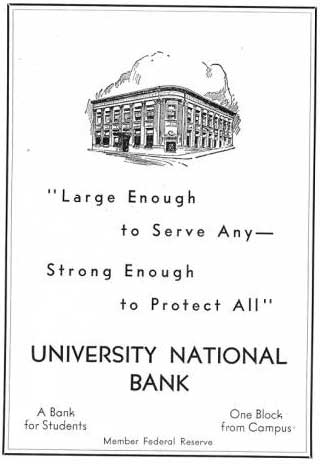
An advertisement from the University of Washington yearbook, the Tyee, from 1933. Note that the advertizement mentions that the banking company is "stiff enough to protect all," an implicit reference to the recent failure of the nation's banks. The banking crisis and land-broad and so national closure of banks during the leap of 1933 preserved public faith in American finance and allowed the newly-elected Roosevelt administration and Congress to stabilize the American economical system. Businesses and people across the country found various artistic ways to proceed business concern running during the bank closures, relying on a system of checks, credit, and payment slips. (Courtesy of the University of Washington Library, Special Collections)
Simply days before Franklin D. Roosevelt'south inauguration every bit President, the U.s.a. was in the middle of a banking panic. On March 3, 1933, Washington Governor Clarence Martin closed all Washington Country banks and declared a three-twenty-four hours "bank holiday," working with other state governments to pushing for the passage of a federally mandated bank holiday. The banking organisation was unable to keep upwardly with the panicked withdrawals that customers were making from their bank accounts, rendering banks incapable of providing money many customers had deposited. With the passing of Washington State Senate Bill No. 185 on March two, 1933, Governor Martin was able to forcefulness a temporary closure of all state banks.
This holiday lasted longer than iii days, however, after newly elected President Roosevelt declared a nation-wide banking concern holiday from March sixth until the 9th, which would afterwards be extended to March 13th. This was a period of economical stress, inability to effectively use earned money, and difficulty in ownership goods. Seattle residents' survival tactics during this fourth dimension provides a window into agreement how the United States equally a nation was able to weather the bank holiday and financial panic using checks and credit as currency, exhibiting the interdependence and creativity that the financial crisis required of ordinary people. Nationally, the Roosevelt Administration and Congress' actions in this period tin be seen as i of the most important legislative deportment of the Bully Depression era, for their management of the 1933 banking crisis preserved American capitalism, gained public credibility for the ability of government to solve the crunch, and set in place a template for future solidification of the American economic organization.[one]
The state of American banks in 1933 was unsure, and there was widespread fear, based on previous closures, that banks funds were mismanaged and that hard-earned deposited money could disappear overnight. The American banking system was a patchwork of branch banks, which could share funds and resources across localities, and local unit banks, which were more vulnerable to the crisis. State laws in many states prevented branch banks from developing, making many state's banks increasingly vulnerable equally the 1929 crash reduced customers' ability to pay back loans. As payment of loans and deposits provided most of the greenbacks flow and backing of American banks, this put banks in constant need of money in guild to hand out withdrawals and pay their creditors, leading to banking concern closures.[2]
Even more, fiscal mismanagement and elite corruption ruined banks and destroyed public religion in American finance. In December, 1930, the Banking company of U.s.a. in New York Urban center closed, locking up over $286 1000000 belonging to more than 400,000 people.[3] The problem started with the two heads of the Bank of U.s., Bernard Marcus and Saul Vocaliser, purchasing their ain bank's stocks with bank funds to drive up prices, giving out tremendous amounts of loans, and using bank assets for their own personal real estate dealings. Upon a semiannual review by the New York State Banking Department, the examiner reported that many of the bank's $70,314,423 in real estate holdings were frozen, that loans to affiliates should exist reduced, that the banking company should not borrow from the Federal Reserve in order to lend to its subsidiaries, and that loans whose only security was the bank's own stock should exist removed.[4]
Marcus and Vocaliser had announced they had a solution to the problem, all the same continued illegal operations in club to facilitate a merger and cover their tracks. Eventually their holdings were facing huge depreciation and stocks were selling at $40 per unit. From their loans totaling more than than $37 million, they judged that some $ix million were doubtful, $fourteen million slow, and the other $fourteen million subject to criticism for being repaid.[5] Marcus and Singer kept this data to themselves, claiming that they could report much larger capital, surplus, and undivided profits to the directors. The bank was having difficulty finding a merger and eventually their difficulties became public on December 10th, resulting in huge amounts of depositors withdrawing their savings from Banking company of United states branches.[6] This panic was unavoidable; fifty-fifty with cash beingness rushed to branches the demand was ceaseless, equally people sought to withdraw entire accounts in society to not lose their money.
By Dec eleven, 44,000 depositors had accounts of less than $400, and both Marcus and Singer were sent to jail.[7] As historian Susan Estabrook Kennedy states information technology in her book, The Banking Crisis of 1933, "the closing of the Depository financial institution of U.s. illustrated that combination of inept management, government timidity, and impersonalization of finance which had brought downwardly more than five,000 banks during the 1920s and would topple another 5,000 in the first three years of the Great Depression."[8] This banking crisis sparked fear in depositors all across the nation, causing many people to hoard their cash, even withdrawing funds from financially sound banks. Over the adjacent three years, banks were hit past more and more similar situations similar the Bank of United States faced, causing, as Kennedy stated, thousands of banks to go under. Given the national banking crunch at hand, many states were taking matters into their own hands towards the end of Herbert Hoover's presidency in 1933.
By belatedly February 1933, and early March, many states had already airtight their banks indefinitely, or had declared a cyberbanking holiday, with California announcing a holiday on March 2nd.[9] By March tertiary, 5,504 banks with deposits of $3,432,000,000 had closed their doors throughout the nation, whether permanently or temporarily, by governor-decree. The Federal Reserve Board, on March 3, insisted on banks' temporary closures and fifty-fifty drafted an order declaring a national banking concern holiday, simply it was dependent on the signature of the President.[ten] Hoover refused to hold to the national bank holiday, and the severely damaged nevertheless nationally visible New York and Chicago banks remained open, also agape to take the blame of closing themselves yet trying to get their state governors to guild a closure to avoid bank failures.[xi] Considering of Hoover'southward inaction, New York governor Herbert Lehman announced a statewide vacation at 2:30 AM on March fourth, followed past the governor of Illinois.[12] At this point, the crisis was so dire that bankers themselves were pushing for governor assistance, withal many governors were agape to act without a federal and presidential mandate. Although Hoover had failed to act, governors and bankers began taking their own steps in the hopes of forcing Franklin Delano Roosevelt to mandate closure subsequently his inauguration on March 4th.
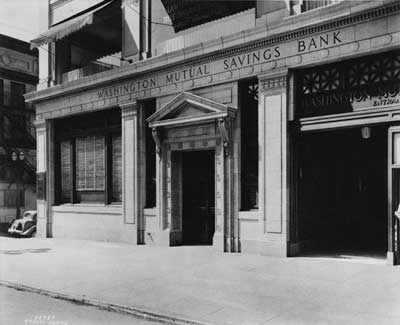
The facade of Washington Mutual Banking concern in Seattle, 1938. Though Washington Mutual weathered the crunch of 1933, they couldn't overcome the Great Recession of the 2000s. Click image to enlarge. (Courtesy of the Museum of History and Industry)
As part of this push button, on March 3, 1933, Governor Clarence Martin of Washington Land alleged a 3-day banking holiday. Martin, along with several other state governors, proclaimed these holidays in response to u.s. that declared holidays out of necessity, and in Washington'due south case also to give support for California's moratorium, the Pacific coast's master financial state.[13] In his statement authorizing the beak, Martin stated that although the banks would be legally airtight on holiday, other businesses and schools would operate normally. Some banks chose non to take part in the state-wide holiday, like the banks of Walla Walla County.[xiv] In the Seattle Daily Journal of Commerce, concerned with local and national business organisation dealings, Washington'southward bank holiday was compared to Oregon's land action, which was also a three-24-hour interval banking moratorium. Oregon Governor Meler made some changes to his vacation, yet, authorizing Portland banks to limit withdrawals to $25 except for mortgage payments and other emergency needs. However, paychecks, no affair for what sum they were fatigued, were being honored by all banks.[15]
Subsequently this first day of the Washington bank holiday a March quaternary article in the Seattle Daily Periodical of Commerce explained how to stimulate Seattle's business during the closure. The article argued that ane of the best methods of stimulating business locally would be the issuance of clearing business firm certificates by banks rather, rather than limiting the amount of withdrawals, every bit Oregon had washed.[xvi]
Seattle'southward popular newspapers gave a detailed business relationship of what the Washington-state banking holiday really meant in their March 3rd problems. The Seattle Star explained that the bank holiday in Seattle meant that neither withdrawals nor deposits could be made, and the safety deposit departments would as well be closed. For all intents and purposes, the banks would be considered airtight and on holiday, while businesses would go on as usual. In addition to making this clarification, the Seattle Star besides reassured its readers that the situation needed patience, not hysteria. The author, seemingly fond of metaphors, argued that Seattle needed to sit tight in the boat but go on pulling the oars, and went on to reassure readers virtually the solidity of Washington'due south banking structure. The Seattle Star reported that the Washington moratorium was patterned after like moves in other states, not because of any weakness in Washington's cyberbanking construction. Seattle's banks especially had kept themselves in stiff condition, having the highest degree of liquidity, or the ability to pay in cash, in the country.[17] The Seattle Post-Intelligencer, another local newspaper, reported on the difficulties the closure could produce for businesses that remained open: for example, stores and business organisation houses needing small alter to carry on business would have to seek accommodation outside of banks.[eighteen] Yet the Seattle Star maintained its positive stance past saying that upon the banks reopening they will open under regulations dictated by reason, that the banks will exist better suited to protect the people. They urged the reader to believe their coin would be safer, and their jobs and businesses likewise. The article again used the metaphor proverb, "This incident proves, again that we are all in the same boat. All right, allow'south sit tight in the boat just let's keep pulling hard at the oars."[19] The newspapers exhibited huge patriotic conviction in the government'south, and Roosevelt's, ability to solve the cyberbanking crisis. Articles like these were important in alleviating whatsoever worries readers might accept had and to convince them to trust in the country's ability to weather the crunch.
Aside from the fears of the general public, Seattle merchants and business organization owners were also concerned about the closure, and they quickly conferred on the morning of Friday, March 2, to make plans for conducting business organization ordinarily without cash. Information technology was decided that charge accounts in proficient continuing would be connected, and personal checks from customers for the exact amount of purchase would exist accepted. Store checks were to be given for alter on payroll checks tendered in payment of purchases, but greenbacks refunds were not to be made. Grocers and other food dealers besides made plans to take care of the needs of their customers for the holiday, which would terminal until Tuesday, March 6. The Seattle Star bodacious the public that utility companies would go along to have checks in payment of bills, as usual. The manufactures explained the planning of business organization leaders however kept the bank closure in a positive lite, arguing that the holiday would give banks time to plan for future business and ensure the safety of all deposits.[20]
The second mean solar day of the bank holiday, Saturday, March iv, found Seattle adjusting its business affairs to meet the situation with courage and resourcefulness. Governor Martin made some changes to the vacation rules to convalesce some stress, near notably allowing rubber deposit box holders full admission to their holdings and making change for users with very large cash bills who could not make change elsewhere.[21] Stores and business houses continued business every bit usual with individual credit taking the place of currency where necessary.[22] The New York Stock Exchange and Seattle Stocks were airtight on March 4 too, in tandem with the bank holidays.
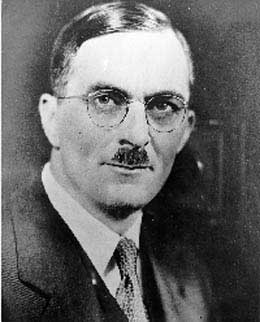
Washington Governor Clarence Martin, a fiscally conservative Democrat, who ordered a state-wide banking concern closure concurrent with other states across the nation who were seeking to pressure the incoming Roosevelt assistants to stabilize the banking system.
Seattle's Retail Trade Bureau chairman, Max A. Silver, announced on March 4th that during the bank holiday large stores in Seattle would operate under sure agreed-upon regulations.[23] First, customers would be asked to give personal checks in the exact amount of the purchase or payment, and that payroll checks or checks of well-known companies would also be accepted on account for purchases, with store checks being given for the amount of the deviation. For returned trade, credit slips or store checks would be given instead of cash refunds. The stores could not cash checks, coin orders, warrants or traveler's checks, but of course, they could accept cash as payment if the client had it and was willing to spend information technology.[24] In the case of federal employees information technology was mentioned that they were to be paid with checks drawn from the United states of america Treasury and their checks could be cashed at the post office. The Seattle Retail Grocer's Clan stated that Seattle's retail grocers had not yet fixed upon any gear up policy during the bank holiday: larger stores that had a credit business were taking personal checks, simply the "cash and carry" stores were only able to rely on customers with cash.[25] In general businesses were able and willing to take checks instead of cash, signaling their faith that the banks would resume regular operations presently. The system was working exceptionally well and businessmen were overall "quite satisfied," the upbeat Seattle Star reported on March 4th.[26] Newspapers bodacious the public that local Seattle companies like the Pacific Telephone & Telegraph Co. and the Puget Audio Power and Lite Co. were accepting personal checks for their corresponding bills.
Ane of Seattle's bigger newspapers, the Seattle Post-Intelligencer, pushed a constant message as their solution to the banking crisis: buy American. This message carried over from Hoover'south presidency and marked the P-I's conviction that America's economic situation would ameliorate with increased sales for American industry. The P-I put this "buy American" spin on the Star's message of positive collectivity, writing of Seattle'southward Ford Motor Company that "Every car bought from this plant means ix days' work for some Seattle mechanic. Buy American!"[27] Both the P-I and the Star sought to reassure readers in different ways that if they banded together, they could survive the depository financial institution closure and help the economy.
Inaugurated in the centre of these country-mandated cyberbanking holidays, the new President Roosevelt was quick to act on the matter. Roosevelt called a nation-broad four-day banking vacation on March half dozen, buying fourth dimension for his advisors to come up up with a more long-term solution. In Roosevelt'southward announcement of the federally mandated banking company holiday, he argued that it was necessary because of "heavy and unwarranted withdrawals of gold and currency from our cyberbanking institutions for the purpose of hoarding."[28] Nevertheless it is too likely that Roosevelt's four-day closure was heavily influenced by the pattern of state-broad bank closures that had taken place at the end of Hoover's term.
Roosevelt ordered that during the holiday no banks should "pay out, consign, earmark, or permit the withdrawal or transfer in whatever manner or currency, or have any other action which might facilitate the hoarding thereof; nor shall any such banking institution or co-operative pay out deposits, make loans or discounts, deal in foreign exchange, transfer credits from the United States to any place abroad, or transact any other banking business whatsoever."[29] Historian Susan East. Kennedy explains the state of affairs, stating that Roosevelt left room in the proclamation for the Secretary of the Treasury, William Woodin, to let normal or usual banking functions, the issuance of scrip, and creation of special accounts for new deposits where necessary.[30] Roosevelt limited the initial moratorium to four days, but intended to implement it again later, as he correctly idea it would be unwise to append banking indefinitely in the offset closing.[31]
Roosevelt's administration began planning the solution to the banking crunch immediately after the bank vacation was proclaimed. Initially, scrip—newspaper currency—was used as a temporary solution to the lack of available cash. The Seattle Mail service-Intelligencer appear on March 6th that an issue of $25,000,000 in scrip was authorized to be printed in the region, with $15,000,000 printing immediately. Scrip was guaranteed to be accepted past banks, and merchants were told to accept the certificates in lieu of the current currency used in exchange.[32] The newspaper added that once the scrip was in circulation that checks could be cashed in for scrip, and that all concern would continue as normal with the employ of the new "coin".[33] Even without the issued scrip issued, Seattle'southward concern had carried on through starting time of the state-wide banking holiday. The Seattle Star reported on March seven that "businessmen generally awaited the outcome of scrip eagerly, confident that the certificates would greatly stimulate merchandise, thinking people volition not be so anxious to hoard scrip."[34]
Seattle newspapers reported on ways that businesses were aiding their employees during the cash shortage and bank holiday. The Seattle Star carried a story describing how Boeing Airplane Co. had purchased three,000 streetcar tokens and bundled credit for gasoline and groceries for its ane,650 employees, since workers had received paychecks on March 4th that they were unable to greenbacks due to the holiday.[35] The Seattle Daily Times reported that at the Fisher Flouring Mills, the company was fix to greenbacks checks for its employees and had offered automobile tokens and credit at sure stores. The Ford Motor Company branch in Seattle was also cashing checks for its workers. The Puget Audio Power & Light Company and the Pacific Telephone & Telegraph Company reported they were making cash advances to their employees confronting money due them on the payroll, sufficient to have care of necessities. The Seattle Daily Times besides added that the Western Dairy Products Visitor had paid its employees past check as usual only that it had offered to cash these checks for employees if needed.[36] Some of Seattle's bigger retail stores, similar Frederick & Nelson, The Bon Marche, and Rhodes Department Store, normally paid their employees in cash, and this custom was continued throughout the holiday.[37]
The Seattle Post-Intelligencer also gave reports of businesses that were willing to help the entire community, not just their employees. The Firestone Service Stores, Inc, for instance, alleged that bank holiday or no banking company holiday they would cash checks in the regular guild of business, merely every bit they had done in the by, and that they would also have checks. A Firestone managing director was quoted equally maxim that "we have every confidence in Seattle's banking interests and we will accept checks to the corporeality of buy on any Seattle bank. The credit of our customers remains unimpaired at any Firestone Service Store." Firestone too inverse their hours to remain open longer on Sundays, from 8am to 6pm, for the convenience of the customs and its customers.[38] Even entertainment industries began to accept checks and IOUs instead of cash, the P-I reported on March 11, equally Seattle theaters the Paramount, the Fifth Avenue, the Coliseum, the Egyptian, and the Neptune instituted policies to lessen the bear upon of the cash shortage on their business.[39]
On Wednesday, March 8th, Secretary of the Federal Treasury William Woodin had begun allowing banks to cash small checks to the corporeality of $25 on a example-by-case basis if sufficient need could be determined. This was to ensure that no people were put in too dire a state of affairs earlier the circulation of scrip, which was expected to begin on Friday, March x. However, it turned out that scrip was never put into circulation in Seattle, and plans for its use were abandoned on Friday, March 10th when Seattle banks decided to file for reopening.
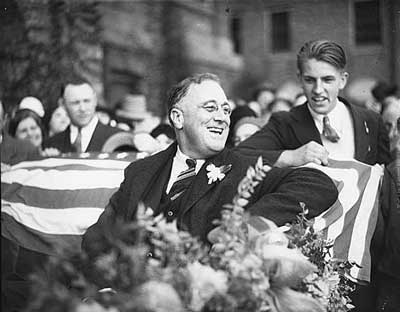
Franklin Delano Roosevelt in Seattle in 1932. President Hoover had refused to mandate a nation-wide depository financial institution holiday and thus allow for big-scale Congressional reform to the American banking system. Pushed by local banks so land governors hoping the new President would act, Roosevelt'due south administration closed down banks nationwide and developed a strategy for preserving American capitalism and resotring public faith in the American banking system. Click epitome to enlarge. (Courtesy of the Museum of History and Manufacture)
Roosevelt signed the Emergency Banking Act of 1933 on Thursday, March ninth, and shortly afterward issued a proclamation extending the holiday indefinitely.[twoscore] With the Emergency Banking Human activity, Roosevelt announced that instead of issuing scrip, Congress was working on a nib to manage the banks and come up with a longer-term solution. Because the issuance of scrip was abandoned, the nation's twelve Federal Reserve banks were allowed to open on the 7th day of the banking vacation, March 11th, to distribute new money and make loans to approved banks.[41] The Emergency Banking Act not simply approved the initial vacation implemented by Roosevelt, but also gave him the power in a fourth dimension of national emergency to regulate or prohibit operations in member banks of the Federal Reserve System.[42] Nether this act, banks could apply for licenses to reopen—equally Seattle's banks did on March 10th—, which would exist issued by state government if the banks were accounted sound and reliable. State government or reserve banks would then review applications, determine if banks were financially sound, and and then assure the support of the Federal Reserve through the banking concern'southward reopening period, though the government did not guarantee that information technology would back bank deposits.[43]
The Emergency Banking Act organized the nation'southward banks into three categories when determining their soundness and power to continue business. About 50% of the nation'south banks, belongings almost 90% of the land's total resources, were judged to exist safe and allowed to reopen by March 15.[44] Forty-five per centum of the nation'southward banks were placed under conservators, or regulations, and were only able to pay out a sure percentage of deposits. These banks were subject area to reorganization overseen by the Reconstruction Finance Corporation, while the remaining unstable banks, approximately five% of the nation's total, were closed permanently without whatsoever plans for reorganization.[45] On Monday, March 13th, banking truly resumed across the United States with the opening of licensed institutions in each of the twelve Federal Reserve cities. These banks opened with full facilities and sufficient supplies of Federal Reserve notes.[46]
Seattle banks, which were opened on March 14th, were faced with a huge amount of deposits, totaling effectually $20,000,000 on the outset twenty-four hours of reopening.[47] Despite previous fears of mass withdrawals, banking concern customers nationwide seemed to have developed a newfound trust in the national banking organisation and federal oversight of financial institutions. The Seattle Daily Times reported on Thursday, March 16th, that thousands of banks had reopened without restrictions and that nation's fears should exist put to rest by the at present-stable banks.[48] Depositing money into the banks had become a patriotic act, signifying confidence in Roosevelt's administration, and a symbolic human activity of communalism and trust that other Americans would do the aforementioned. An commodity in the Seattle Daily Journal of Commerce depicted this new sentiment with a curt fiction. While continuing outside a Seattle bank, a homo skeptical of the bank's recovery was shown considering taking out a withdrawal. Though he was reluctant to effort, the man "put on his disguise (false whiskers)" and walked upwards to the banking window. When he whispered to the bank teller, meekly asking for two dollars, the teller gave a broad smile and handed him 2 dollars from a big stack, with no debate or pause. The story concluded with the human being albeit that he didn't really need the money and was but testing the banks for their soundness, and announcing his intention to promptly re-deposit his two dollars to show his back up of the banking organisation.[49]
Seattle's feel was similar to the reactions of the public nation-wide. Individuals responded skilful-naturedly to the banking holiday, despite the general fear many had of the banks' financial weakness. Many speculated that if nothing else, suspension of all banking at least gave some respite from the constant and depressing reports of bank failures.[50] People came up with creative ways to conduct business during the vacation: on a Table salt Lake Urban center trolley, a pair of trousers paid one man'southward fare, Alaskan miners used gold dust to replace modest alter, a Philadelphia department store allowed customers to accuse streetcar tokens on their credit accounts, and the Lewiston, Montana Democrat-News accepted ten bushels of wheat in payment for a yr'southward subscription. An Oklahoma Metropolis hotel agreed to accept payment of guest's bills with "anything nosotros can utilize in the coffee shop," resulting in a patron paying with a pig.[51] It seems that despite the lack of cash, few travelers nation-broad suffered from the lack of real coin, as railroads accepted checks for passenger and freight charges, and most tourists remained on holiday and sustained themselves by postal coin orders and $50 advances from the American Express Visitor.[52]
For about a calendar month deposits to United States banks far exceeded withdrawals. In the example of the Federal Reserve Bank of New York, $18 million was paid out to its member banks, while information technology took in $27 million.[53] The reopened banks as well managed to spark business activity nation-wide, aided by the new circulation of cash and the nation's diminishing fearfulness of spending. Stock exchanges were reopened and stocks rose steadily, with regime bonds, corporate bonds, and other bones commodities rising.[54] Though retail reported virtually-normal business concern interactions, non all industries were able to option upward their old levels of productivity. The automobile industry and public structure, for instance, remained slow and unaffected by the banks reopening.[55] Many banks still needed reorganization and many others were express by conservators, but the nation was on its way to a recovery from the severe 1933 banking crisis.
Seattle'south situation during the banking crunch was similar to many other cities in the United States. Common survival techniques arose as cash became scarce, as businesses and groceries accepted credit and paychecks and gave change in their own company checks. Many larger businesses sought to assist their employees and community during the bank vacation by issuing cash or providing transportation fare.
Though land banks had forced their governors to declare state-wide bank holidays in response to President Hoover's inaction, making it near-impossible for Roosevelt to exercise anything other than issue a federal mandate, he was able to move quickly to prevent whatever farthermost impairment to the banking arrangement or federal finances, and to prevent a wholesale loss of public religion in the American economic system.[56] Indeed, the containment of the banking crisis in 1933 and the creative means that local businesses and ordinary people developed to survive the crunch and continue business running seemed a good omen for Seattle and the nation'south ability to save the American economic system during the Bully Depression.
Copyright (c) 2010, Drew Powers
HSTAA 498 Winter 2010
[1] Erik Rauchway, The Bang-up Low and the New Deal: A Very Short Introduction (New York: Oxford University Press, 2008), 57-59.
[ii] Erik Rauchway, The Bully Depression and the New Deal: A Very Short Introduction (New York: Oxford University Press, 2008), 30.
[3] Susan Estabrook Kennedy, The Cyberbanking Crisis of 1933 (University Press of Kentucky, 1973), 1.
[4] Kennedy, The Cyberbanking Crisis of 1933, 2.
[five] Kennedy, The Banking Crunch of 1933, 3.
[half dozen] Kennedy, The Cyberbanking Crisis of 1933, four.
[vii] Kennedy, The Banking Crisis of 1933, iv.
[8] Kennedy, The Banking Crunch of 1933, five.
[9] Kennedy, The Banking Crunch of 1933, 144.
[10] Kennedy, The Banking Crisis of 1933, 144.
[xi] Kennedy, The Banking Crunch of 1933, 150.
[12] Kennedy, The Banking Crisis of 1933, 150.
[13] "Here is what the bank holiday actually means," Seattle Star, March 3, 1933, 1.
[xiv] "Walla Walla County Banks Remain Open, Seattle Postal service Intelligencer, March 4, 1933, 8.
[xv] "All pay checks honored past banks in Portland," Seattle Daily Periodical of Commerce, March 4, 1933, 1.
[16] "To Stimulate Business," Seattle Daily Journal of Commerce, March iv, 1933, eight.
[17] "Sit Tight in the Gunkhole But Keep Pulling the Oars," Seattle Star, March 3, 1933, i.
[18] "Governor Takes Immediate Activity Under New Law," Seattle Postal service Intelligencer, March 3, 1933, one.
[19] "Sit Tight in the Boat Simply Keep Pulling the Oars," Seattle Star, March 3, 1933, 1.
[20] "Sit down Tight in the Boat Only Keep Pulling the Oars," Seattle Star, March 3, 1933, 4.
[21] "Seattle Set for Holiday," Seattle Star, March 4, 1933, three.
[22] "Seattle Set for Holiday," Seattle Star, March 4, 1933, three.
[23] "Rules for Stores," Seattle Star, March 4, 1933, three.
[24] "Rules for Stores," Seattle Star, March 4, 1933, 3.
[25] "Rules for Stores," Seattle Star, March 4, 1933, iii.
[26] "Pay Checks Issued," Seattle Star, March 4, 1933, 3.
[27] "M'Kay Urges 'Purchase American'," Seattle Post Intelligencer, March two, 1933, 5.
[28] Kennedy, The Cyberbanking Crisis of 1933, 158.
[29] "The President's Annunciation," Seattle Postal service Intelligencer, March half-dozen, 1933, 1.
[xxx] Kennedy, The Cyberbanking Crisis of 1933, 159.
[31] Kennedy, The Banking Crisis of 1933, 160.
[32] "The President's Proclamation," Seattle Post Intelligencer, March 6, 1933, 1.
[33] "President Orders 4-twenty-four hour period vacation for Banks, Bans Gilded-Hoarding," Seattle Post Intelligencer, March 6, 1933, 1.
[34] "Seattle Banks Ready to Open, Seattle Star, March 7, 1933, 3.
[35] "Boeing Co. Supplies Employees With Food," Seattle Star, March 4, 1933, 3.
[36] "Seattle Firms Supply Cash to their Employees," Seattle Daily Times, March vii, 1933, v.
[37] "Seattle Firms Supply Cash to their Employees," Seattle Daily Times, March 7, 1933, 5.
[38] "Firestone will Cash Checks," Seattle Post Intelligencer, March 5, 1933, 11.
[39] "Theatres here accept checks," Seattle Post Intelligencer, March 11, 1933, 10.
[forty] Kennedy, The Cyberbanking Crisis of 1933, 177.
[41] "Banking Holiday Extended by Roosevelt; Senate and Business firm Laissez passer Emergency Neb," Seattle Daily Journal of Commerce, March 10, 1933, ane.
[42] Kennedy, The Banking Crisis of 1933, 177.
[43] Kennedy, The Cyberbanking Crisis of 1933, 179.
[44] Kennedy, The Banking Crisis of 1933, 187.
[45] Kennedy, The Banking Crisis of 1933, 187.
[46] Kennedy, The Banking Crisis of 1933, 187.
[47] "Deposits Swamp Seattle Banks," Seattle Daily Times, March 14, 1933, 1.
[48] "Conviction and Currency Flow Enliven Banks," Seattle Daily Times, March sixteen, 1933, 1.
[49] "He Got His 2 Dollars, But Today information technology Goes Back to Depository financial institution Where it Belongs," Seattle Daily Journal of Commerce, March 15, 1933, 10.
[50] Kennedy, The Banking Crisis of 1933, 161.
[51] Kennedy, The Banking Crunch of 1933, 161.
[52] Kennedy, The Banking Crisis of 1933, 161.
[53] Kennedy, The Cyberbanking Crunch of 1933, 187.
[54] Kennedy, The Banking Crunch of 1933, 188.
[55] Kennedy, The Cyberbanking Crunch of 1933, 189.
[56] Kennedy, The Banking Crisis of 1933, 189.
Source: https://depts.washington.edu/depress/bank_crisis_1933.shtml
0 Response to "Banking Relief Act to Help Banks Reorganize and Open Again"
ارسال یک نظر